Lesson #126: Urdu Vowels Part 4: e
I do admit it’s unfortunately been a while since we last saw a lesson on Urdu, can you still remember everything we’ve covered so far? Let’s recap quickly then! We’ve seen six Urdu vowels; a and aa, i and ee and finally u and oo. We’ve also seen our first Urdu consonant; be. Be sure to head back to the respective lessons if you feel your memory is a little hazy! You should be able to recognise all the vowels in the word below (and only the vowels, we haven’t seen the consonants yet!) so go on give it a go…

 duniyaa - The World
Feel free to head back to the older lessons if you got stuck a little! Anyway today we’re going to look at just one more Urdu vowel, e. How easy does that sound? Plus in the process we’ll learn a whole new letter of the Urdu alphabet! So are you all ready to get going? Great! Here goes…
If you can’t see the play button or if it wont work then click here for instructions on how to fix it!
Our vowel for today is the vowel e. It’s ‘equivalent’ to the Hindi vowel ए e. This vowel is a little tricky because it’s not really a sound we’re used to in English. Save me trying to explain and confusing you more just click the play button above to hear the vowel pronounced! Be sure to listen to it many times to make sure you get the pronunciation perfect!
So that’s the pronunciation done, now how do we write this vowel? Well remember of course, that this changes depending on where the Vowel is in a word!
To start a word with our new vowel e, we actually start the word with an alif and then add a chotee ye after. Perhaps you’ve forgotten what those are, so let’s look at an example…
 ek - One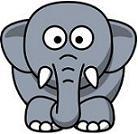
Can you see the alif and chotee ye at the start? The alif is the straight line, and the chotee ye has two dots under it! Got it? Great! These two letters mean we start the word with our ’e’ sound!
Now if you’ve got a good memory you might suddenly see a huge problem that is inherent Urdu writing. Remember back in Lesson #95 we saw the vowel ee? You should remember that if we want to start a word with the vowel ee we actually do exactly the same; start with an alif then a chotee ye. So uh-oh how do we tell whether a word starts with an e or an ee? Well the truth is there is no way of telling, you must simply know the word already and know how to pronounce it! Sound tricky? Don’t worry, the more Urdu words you see the easier it will be, I promise.
Read that paragraph above through again, because it’s a very important paragraph. So let’s carry on, how do we put the e sound in the middle of a word? We actually use our friend chotee ye again. Do you think you’re ready for a few examples? Here we go…

 sher - Tiger
Can you spot the chotee ye in this word? That’s right, we know we’ve got a chotee ye because we have the two dots just underneath the word!
Again alarm bells might be ringing in your head! This is exactly how we show the vowel ee in a middle of a word, as we saw in Lesson #95. Again (if vowel markers are not there!) you simply have to know whether or not the word uses the vowel e or ee. They may be written the same way in Urdu script but they are pronounced completely different! Let’s see another example…
 mez - Table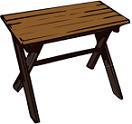
Can you see the two dots under the word again? Great! That means we have the e vowel in the middle! Got that? Great. So how do we write e at the end of a word? Well first we must learn a new letter of the Urdu alphabet! Ready? Here goes…
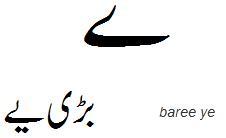
This is the letter baree ye. Can you see it sitting at the top of the picture there? It looks a little like a boomerang don’t you think? Anyway this letter is only ever used at the end of a word, when we want the e sound. Because as we’ve just seen when we use e in the middle we use chotee ye!
So anyway lets see a few examples of baree ye in use…

 kele - Bananas
Can you see the baree ye here? That’s right, it’s the big hook at the end, it comes down and sits right under the word. There’s actually two e’s in this word, can you spot the other one? That’s it, the two dots under the baree ye are actually part of the chotee ye from e in the middle of the word! Let’s see another example…
 pyaale - Cups
Can you spot the baree ye this time? Yeah that’s right, it’s the big hook at the end again! Well done!
So that’s the end of the lesson, give yourself a pat on the back for reading all the way through. I do admit it’s been a tricky vowel today. There’s a few important things to remember from today’s lesson so here they all are to make sure you don’t forget them…
- When we want to start a word with e we use an alif first then a chotee ye
- When e comes in the middle of a word we use chotee ye
- When e is at the start or in the middle or a word there no written difference between it and another vowel we’ve already seen, ee, however they are very different in pronunciation so it’s important to know which is correct!
- When e comes at the end of a word we use our new letter; baree ye.
Phew ok that’s it! We’ll be seeing loads more examples as we carry on but hopefully you’re getting the idea. Make sure to check back to the audio file at the start of the lesson to hear the letter pronounced over and over! Also make sure you can spot our vowel e in each of our example words through the lesson!
If you’ve got any questions or comment then please be sure to leave them in the comments section just below!


