Lesson #95: Urdu Vowels Part 2: i and ee
So what did we learn in our last Urdu lesson? Can you remember? We saw the the first two Urdu vowels, a and aa. We also learnt the very first letter of the Urdu alphabet; ا alif (it’s just a straight line down, I mean how easy can you get!). Of course you can recap over all this Lesson #86 if you’ve forgot anything!
Today we’re going to cover the next two Urdu vowels! And as we do this I’ll teach you one more Urdu letter! In this lesson you’ll see a lot of new consonants we haven’t met yet, just don’t worry about them for now!
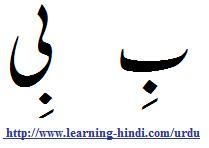
These are the vowels we are going to be learning about today, on the Urdu letter ب be (equivlent to the Hindi letter ब ba). So are you ready to begin?
The first vowel we’re going to learn about today is the vowel i. It’s basically just the same as the Hindi vowel इ i that we learnt about all the way back in Lesson #3. The sound of this vowel is just like the i in the English words ‘pit’ or 'hit’, click the play button just below to hear it pronounced.
If you can’t see the play button or if it wont work then click here for instructions on how to fix it!
Now when we want to start a word with the vowel i in Urdu then we our letter alif again, but this time put what’s called a Zer (or Kasra) undearneath. It’s basically just a little dash that sits under the alif . Let me show you an example….
 idhar - Here
Can you see underneath the alif that there’s a little dash? That’s the Zer, and using the Zer on an alif at the start of a word means we start with the i sound! Remeber that alif never joins to the next letter. Are you following? Do you want to see another example?
 insaan - Human
Can you see the Zer underneath the alif here? Great!
Now when we want to add i in the middle of at the end of a word (ie when we want to add it to a consonant) we simply write the Zer underneath that letter, simple! So for example, again just like Hindi…

 kitaab - Book
Can you see the little dash underneath the first letter? (Remember the first letter is on the right!) The Zer means we add an i sound to the letter, in case that means we say ’ki’! Another example is…
 dil - Heart
Can you see the Zer here? Great! Guess what? That’s one vowel finish! Ready for learn about the next vowel? Firstly we need to learn a new letter!
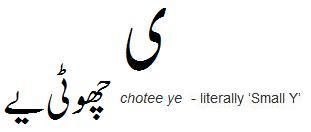
This is one of the very last letters of the Urdu alphabet, it’s called چھوٹی یے chotee ye - literally 'Small Y’. It looks a bit like a slanted S with a big tail, or a bit a like a swan. This letter can be quite confusing because it has several uses, but i’ll introduce them all when the times right! For now we’re just going to use it for our next vowel which you’ll see in a second.
Can you remember back to An Introduction to the Urdu Alphabet when I told you that letters change shape depending on where they are in a word? Well ی chotee ye is an example of a letter that changes a lot!
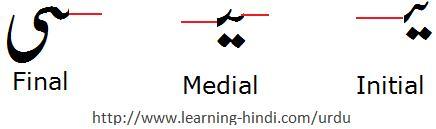
This is how the letter ی chotee ye changes when it’s in the different parts of a word. The red line represents the other letters in the word, whatever they may be! When it’s at the start or in the middle of a word it has two dots underneath! (The reason for this originally comes from Arabic but that’s not so important right now).
Our next vowel is ee. This sound is easy, it’s just like the ee in the English word feet or meet, you can listen to it by clicking on the play button just above!
When we want to start a word with the vowel ee we actually use an alif first and then we put chotee ye after and this gives us the ee sound, so for example the word for Faith in Urdu is…

 eemaan - Faith
It’s actually an Islamic term that came into Urdu through Arabic. Can you spot thealif and chotee ye at the start? It might be difficult to spot, but just remember that the chotee ye has two dots underneath! And it gives us the ee sound! Another example is…
 eent - Brick
Can you see the alif and chotee ye here? Very good!
Now when we want to add the ee sound to a consonant we simply put a Zer under the consonant and then a Chotee Ye comes after. For example again just like Hindi we have…

 seekhnaa - To Learn
Can you spot the Zer underneath the first letter and the Chotee Ye just after it? This gives the sound ee after the consonant, so we say see! Do you want to see another example?
 theek - Ok
Can you see the Zer underneath this time (it’s a little hard to see) and then the Chotee Ye again that come after. Great!
Don’t forget that when we have the ee sound at the end of a word the Chotee Ye takes a different shape, as we saw above! For example, I bet you can guess what the Urdu word for cat is, that’s right it’s the same as Hindi…
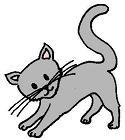
 billee - Cat
Can you see the Zer on the last letter and the Chotee Ye at the end? This means we end the word with an ’ee’ sound. Remember Chotee Ye does not have any dots underneath if it ends a word! Another example is…
 larkee - Girl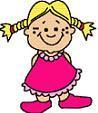
Can you see the Zer and Chotee Ye at the end again? This means we end the word with the sound ee. Great!
That’s it for today! I know it’s been a very long and probably quite a confusing lesson but hopefully it will sink in as I show you more and more examples. For now, just try and remember what we’ve learnt!
Note 1: Like the Zabar that we learnt about last time, the Zer is usually 'dropped’ in most written texts.
Note 2 Only read this if you know Arabic! In Arabic a 'dotless’ ya at the end of a word (known as Alif Maqsura) has the sound 'aa’, for example the word على 'alaa - on. In Urdu a dotless ya at the end always has the sound ee and never aa! This is one difference between written Arabic and written Urdu so be careful when reading and don’t get confused!
