


Lesson #113: Compound Verbs Part 1
Today we’re going to begin to learn about a fantastic feature of Hindi grammar known as Compound Verbs. So what are these ‘Compound Verbs’ and why do we use them? Well basically Compound Verbs are two verbs used together to create a kind of combined meaning. They are very common in both speech and writing and are used to express the manner in which something is or was done. They can literally add a whole new dimension to the meaning of a sentence!
Let me show you with an example just how powerful these Compound Verbs can be first, then I’ll teach you all about them! Are you ready? So we know how to say 'I read a book’, (read - in the past tense sense of the word!) using what we learnt in Lesson #83, it’s just..

मैं ने किताब पढ़ी main ne kitaab parhee
- I read a book
But by simply using a Compound Verb we can change the meaning of this basic sentence quite drastically by saying something like…

मैं ने किताब पढ़ ली
main ne kitaab parh lee
- I read a book to myself
Or we might say…

मैं ने किताब पढ़ दी
main ne kitaab parh dee
- I read a book out loud
Can you see the differences between the three sentences above? We’ve used a different Compound Verb in the last two sentences and it’s quite simply and drastically changed the meaning! The Compound Verb has told us how the action, 'the reading’, was done. So let’s learn a little more about Compound Verbs and see how to use them.
A Compound Verb is made up of two verbs; the first we call the Main Verb and gives the general meaning and the second is known as the Auxiliary and gives the general manner of the action. We always use the root of the Main Verb (remember that’s just it’s infinitive form minus the ना naa from the end) and the Auxiliary is conjugated as normal.
Today we’re just going to look at one Auxiliary, जाना jaanaa. In Part 2 we’ll look at लेना lenaa and देना denaa - which we’ve used in the examples above! After that we’ll look at some more. So let’s get straight to it!
The verb जाना jaanaa means 'to go’, but when used as an Auxiliary in a Compound Verb gives the general meaning of a completed action. So let me show you some example Compound Verbs using जाना jaanaa as the Auxiliary with various Main Verbs…
आना aanaa - To Come - आ जाना aa jaanaa - To Arrive
खाना khaanaa - To Eat - खा जाना khaa jaanaa - To Eat Up
पीना peenaa - To Drink - पी जाना pee jaanaa - To Drink Up
बैठना baithnaa - To Sit - बैठ जाना baith jaanaa - To Sit Down
होना honaa - To Be - हो जाना ho jaanaa - To Become
Can you make sense of this table? We’ve got some Main Verbs on the left with their original meaning and then on the right hand side is their meaning when used as a Compound Verb with जाना jaanaa as an Auxiliary. Can you see how in each case the new meaning is related but still slightly different to the main verb?
So are you ready to see some examples? Great!
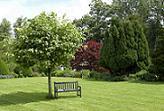
हम बगीचे में बैठ गए
ham bageeche men baith gae
&- We sat down in the garden.
Remember जाना jaanaa is Irregular in the Past Tense! Can you follow this sentence? We’re literally saying 'We garden in sat down’, using our Compound Verb we’ve just learnt! Ready for another example?

देर हो गई है der ho gaee hai
- It has become late.
Here we’ve used the Present Perfect Tense from Lesson #110. In this example we are literally saying 'Lateness has become’. The verb agrees with the Feminine word देर der - Lateness / Delay. Following? This phrase is great to use if you’re ever with people and want to leave because it’s late into night, though many Indians may still insist you stay!

प्रियंका घर आ गई है
priyankaa ghar aa gaee hai
- Priyanka has returned home
Ready for a last example with this Auxiliary?

विराट अपना खाना खा गया
viraat apnaa khaanaa khaa gayaa
- Virat ate up his food
Notice here how we haven’t use ने ne. We only use ने when both the Main Verb and the Auxiliary need it. So because जाना jaanaa doesn’t use ने ne we don’t use it in this sentence.
Something else to notice is that we usually use compound verbs in either the Imperative form or in the Past Tense. We never use them in the Continuous or Future Tense.
Have you followed and understood everything today? If not then please feel free to leave a comment or a question in the comments section just below and I’ll do my best to help you. Well done for reading all the way down here, it’s been quite a long lesson! Now to test your knowledge can you try and translate these three sentences? Why not give a go, leave a comment with your answers!
- यहाँ बैठ जाओ yahaan baith jaao
- मैं चाय पी गई main caay pee gaee
- वह दस बजे आ गया voh das baje aa gayaa (Lesson #57 may help!)
So have a go translating these, just leave a comment below! And again be sure to ask if you have any questions.
Next time we look at Compound Verbs, as I said near the start, we’ll see two more Auxiliaries लेना lenaa and देना denaa!


