Lesson #86: Urdu Vowels Part 1: a and aa
Can you remember what we saw last time in An Introduction to the Urdu Alphabet? One of the things we learnt is that the Urdu vowels are basically just the same as the Hindi ones!
But there are two important differences; the first is that Urdu does not have the vowel ऋ ṛi and the second is that the Urdu script is (obviously!) completely different, so of course we’re going to need to learn how to read and write Urdu vowels!
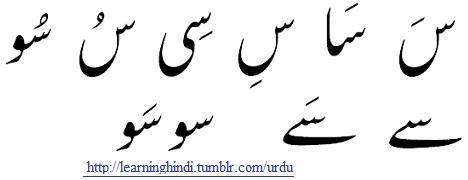
This is all the Urdu Vowels on the letter س seen, equivilent to the Hindi स sa, written in the Nasta'liq style. Does it look confusing? Today we’ll learn more about the first two!
So are you ready? Great! Let’s get straight to it!
If you can’t see the play button or if it wont work then click here for instructions on how to fix it!
The first vowel in Urdu is essentially the ‘same’ as the Hindi vowel अ a. It sounds just like the first 'a’ in the word 'alive’, click the play button above to hear the vowel pronounced! Make sure you listen to it plenty of times so you know it perfectly!
So how do we write it? Well can you remember last time I told you that Urdu letters have different 'forms’ depending on where they are in a word? The vowels are just the same so this means we have to learn how to write the vowel when it starts a word and when it’s in the middle of a word! Before we do any of this let’s learn a letter of the Urdu alphabet! Ready?
 alif
alif
This is the very first letter of the Urdu alphabet and it’s the letter alif. It’s just a straight line down, I mean how simple and easy can it get?! Something very important to note is that alif never 'joins’ on to the next letter!
When we want to start a word with the vowel a we use the letter alif but with something called a Zabar on top of it. What on earth does that mean? Well, this is what it looks like…
Alif and Zabar  a (at the start of a word)
Can you see the little dash on top of it? That’s the Zabar! So for example in the word….
 ab - Now
Can you see our Alif and Zabar at the start? Remember the start of the word is on the right, opposite to what we are used to! Or another example, we have…

 ameer - Rich
Have you got it? So that’s what we do when we want to start a word with 'a’. Now when we want the vowel a in the middle or at the end of a word we don’t use Alif and Zabar, we simply use the Zabar and it just sits on top of the consonant. Oh and by the way, sometimes the Zabar referred to by its Arabic name, Fatha.
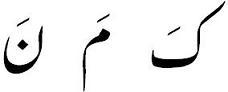
The Zabar on the letters ک kaaf, م meem and ن noon (from right to left, written in Nasta'liq.). Can you see the dash on top of all three letters? That’s the Zabar! The Zabar means we pronounce them as ka, ma and na. Following? Just like Hindi, the Urdu word for pen is….
 qalam - Pen
Can you see the two Zabars here? I admit it is a little tricky to make out, but you should just about see two dashes! Or we also have….

 ghar - House
Can you see our Zabar floating on top? That tells us we make the 'a’ sound! (That bigger line on top of the first letter isn’t the Zabar - that’s part of the letter 'g’, try and not get confused!) And that’s the first vowel done! Easy as that!
Ready for the next one? Next is the vowel aa, the long 'a’ sound. This is just like the Hindi vowel आ aa. It’s pronounced like the 'a’ in the word father. You can listen to this vowel by clicking on the play button just below, be sure to listen to it plenty of times!
When we want to use aa at the start of a word we use our letter alif again, but this time with what’s called a Madda on top of it. A Madda is basically just a squiggly line!
Alif and Madda  aa (at the start of a word)
For example, we have…
 aag - Fire
Can you see the Alif Madda at the start? Just a quiggly line above the alif at the very start of a word! Also we have the word…

 aankh - Eye
Can you spot the Alif and Madda at the start again?
Now when we want the vowel aa in the middle of a word, after a consonant, we simply use a Zabar on the consonant followed by an alif! Remember that the letter alif never joins to the next letter! We don’t use the Madda! Let me show you an example…
 haathee - Elephant
Can you see on the first letter (on the right!) we have the little dash on top - the Zabar, and then the vertical line - the alif, which give it the aa sound - haathee. Remember that alif never joins to the next letter in the word! Another example is…

 becnaa - To Sell
This word might seem a bit more confusing, but just look at the end of the word for now (that’s on the left of the word)! Can you spot the Zabar and the alif? Great!
That’s it for today! That’s actually everything you need to know about the first two Urdu vowels! I’ll be showing you a lot more examples very soon!
But there is one more thing - in most writing the Zabar is not written and you have to kind of 'guess’ that it’s supposed to be there! We’ll learn more about this soon.
How was that, your first proper Urdu lesson! I bet it seemed real confusing. Don’t worry though, I assure you that all it just takes is just some getting used to. Don’t forget you can always ask me questions in the comments section below.


