Lesson #82: An Introduction to The Urdu Alphabet
Last time we looked at Urdu, in Intro #4, we saw a bit of an introduction to the language and learnt how to greet someone in Urdu; assalaam ‘alaikum السلام علیکم .
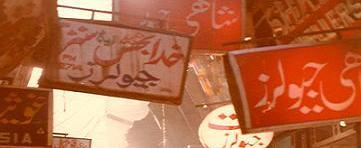
Urdu street signs in Pakistan
Today we’re going to have a very brief introduction to the Urdu alphabet and writing sytem. Luckily for us, many of the Urdu letters are pronounced exactly the same as Hindi ones!
The first and most important thing is that the Urdu script reads from Right to Left and not Left to Right! This was actually mentioned last time in An Introduction to Urdu.
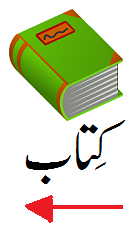
In the picture above we have the word kitaab - Book, it reads from right to left in the direction of the arrow!
This 'backwardness’ can seem very confusing and alien to begin with. Our whole life we’ve been used to reading left to right and suddenly it’s changed round! Eventually though, you’ll get used to it!
The seond important thing is that the Urdu letters actually 'change’ shape depending on where they are in a word. What does this mean then? Well, have a look at this picture…
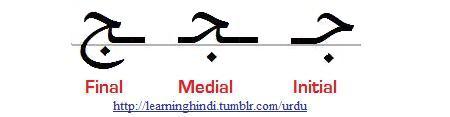
These are all 'forms’ of the letter ج jeem (Equivilent to the Hindi letter ज ja)
You can see that the letter takes a slightly different shape depending on whether it starts a word, is in the middle of a word or ends a word. But notice how all forms of this letter have the same diagonal line and one dot underneath! Can you see the letter ج jeem in the following words below? Don’t worry too much if you cant, it’s only early days still - we’ll be learning a lot more about the letters soon!

Now just like Hindi and English, Urdu is made up of Vowels and Consonants. In a similar way to Hindi, vowels are added to consonants by 'adding something’. In the picture below you can see all the vowels in Urdu on the letter ک kaaf (Equivalent to the Hindi letter क ka)

This probably looks super confusing right now, all these lines and dashes. But don’t worry, slowly we’ll build up more and more and soon you’ll understand it all! All of these vowels above match to one of the Hindi vowels (apart from ऋ ṛi which Urdu does not have).
However, what makes reading Urdu more difficult than Hindi or English is that these vowel markers (the dashes above the letters) are very rarely written, you only really see them in in children’s books and religious writings. So this means you often have to know of simply 'guess’ what the vowel should be! In English this would be as if we always wrote like this….
"ths ’s wht wrds lk lk wtht vwls, cn y stll rd ’t?“ .
If you didn’t figure it out that said 'this is what words look like without vowels, can you still read it? It’s not so hard to read when you know the language but when you’re trying to learn the language it’s a major challenge! I’ll be using the Vowel markers to being with, to help us when we are learning to read. But very quickly I’ll stop using them to get us used to 'real life’ Urdu.
Something else that can make reading Urdu a little tricky to begin with is that most written Urdu is in a form called Nasta'liq. That confusing word is simply a name for a style of writing. Have a look at the picture below…
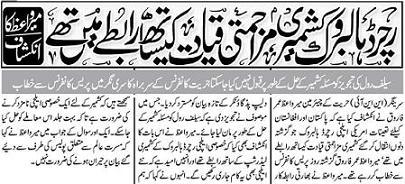
This is a story from the Urdu Newspaper Jang, written in the Nasta'liq script. Notice how, especially in the headline, the letters appear to be all over the place!
Nasta'liq Urdu doesn’t stick to the 'straight lines’ that we’re used to in English and Hindi, often letters in the same word appear to be under and above each other! Learning this Nasta'liq isn’t that difficult though! Because Nasta'liq is the most common form of written Urdu we’ll be focusing on it in all these lessons!
This was quite a long introduction to the Urdu alphabet and there’s still so much to cover so sorry for rambling on so much! Hopefully though, you’ve learnt a few new things today that are going to help you as you learn.


