Lesson #71: Revisiting The Elephant’s Friendship
It was over two weeks ago now, in Lesson #66, that we saw the short Hindi story हाथी की मित्रता haathee kee mitrtaa - The Elephant’s Friendship. The purpose of the exercise was for you to simply listen to the story, see how much you could understand and see how many words you could recongise.
Today we’re going to go through in a little more detail some of the sentences from the start of the story. This should help you understand the story a little more and increase your vocabulary.
So here’s the video again, watch it through once more;
So we’re going to go from the start of the story today and I’m going to completely break it down for you so that you can fully understand what’s being said. We’ll only see the first few sentences, otherwise this will get really long and boring. Ready to begin?
This does get a little complicated but please try your hardest to follow!
The first sentence is;
बहुत पुरानी बात है bahut puraanee baat hai
Any ideas what this means? You should be familiar with the word बहुत bahut - very, because we use it all the time. पुरानी puraanee is the feminine form of the adjective पुराना puraanaa - old (when describing objects only - not people!), and पुरानी puraanee is feminine because it agrees with the feminine word बात baat - which mean can ‘problem’, 'matter’, 'story’ or 'thing’. So if we put this all together we have;
बहुत पुरानी बात है bahut puraanee baat hai - A very old story.
Note there that the translations is not 'unique’. We could say aslo 'A very old thing’ or 'The old matter’, you just have to chose which one 'sounds’ and fits the best.
That’s one sentences done! Now what comes next? Well we have a very, very, very long sentence, ready for it?
एक जंगल में एक हाथी किसी मित्र की तलाश में इधर उधर घूम रहा था ।
ek jangal men ek haathee kisee mitr kee talaash men idhar udhar ghoom rahaa thaa.
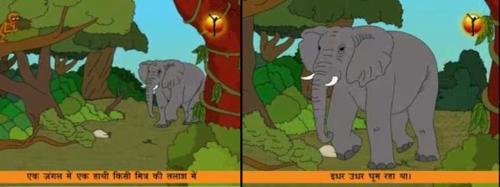
The sentence is so long it doesn’t even fit on one screen of subtitles!
Wow. So where on earth do you start when you are confronted with a sentence in Hindi like this? We’ll simply take it a few words at a time;
एक जंगल में ek jangal men - well we already know एक ek - one and में men- in. The word जंगल jangal is super easy, what English word does it sound exactly like? Jungle - and it’s as easy as that. So we have 'In one jungle’, or 'In a jungle’.
एक हाथी ek haathee - an elephant. That’s easy!
किसी मित्र की तलाश में kisee mitr kee talaash men. So what have we got here? किसी मित्र की kisee mitr kee means 'of some friends’. We know the word friend, it’s in the title! We covered की kee in Lesson #51 it means 'of’ or ’s (apostrophe s). Then the completely new word तलाश talaash, this simply means 'search’.
So far then we have 'In a jungle an Elephant in search of some friends…’ It doesn’t really make sense but don’t worry, we’re not finished yet!
इधर उधर idhar uhdar - This simply means here and there or over here and over there. Together they almost give the meaning of 'everywhere’.
घूम रहा था ghoom rahaa thaa - This is the Past Continous Tense we covered last time in Lesson#70! घूमना ghoomnaa is the verb to roam or to wonder. So we have, applying what we know of the Past Continuous tense, 'was roaming’.
Do you think we can put this all together now? Let’s try; “In a jungle an Elephant in search of some friends here there was roaming" This doesn’t really make much sense does it? We’ve need to 'neaten’ up the English a little, so finally;
एक जंगल में एक हाथी किसी मित्र की तलाश में इधर उधर घूम रहा था ।
ek jangal men ek haathee kisee mitr kee talaash men idhar udhar ghoom rahaa thaa.
In a jungle an elephant was roaming everywhere searching for some friends.
Can you see I’ve reorder some of the words a little just so it makes more sense in English. This hasn’t changed the meaning and it’s something you’re going to have to get used to when translating, unfortunately!
I understand that was probably quite difficult and there was a lot of new words, so don’t worry, just try your hardest to understand the new words we’ve learn.
I want you to try and translate the next few sentences yourself! Try and see how far you can get. Working by yourself on something really is the best way to learn. You may need to use a Hindi dictionary, if you don’t have one yourself you can use a wonderful free website called Shabdkosh (which means Dictionary in Hindi). Let me know in a comment how far you get, don’t forget to ask for help if you get stuck!